


Greenhouse gas (GHG) emissions data from the coal industry remains inaccurate. So far, the government has focused too heavily on carbon dioxide (CO₂), while other emissions, such as methane (CH₄), are largely unrecorded.
Research by the Extractive Industries Transparency Initiative (EITI), together with Publish What You Pay (PWYP), reveals this gap.
Earlier, a 2024 study by EMBER found that emissions from coal mining could be up to eight times higher than official data released by the Indonesian government.
Astrid Meliala of EITI explained that GHG emissions from the coal industry include nitrous oxide (N₂O), hydrofluorocarbons (HFCs), perfluorocarbons (PFCs), sulfur hexafluoride (SF₆), and methane. According to EMBER’s findings, methane emissions from coal mining have a greater impact on climate change than CO₂.
She further explained that emissions from coal companies fall into three categories. First, direct emissions from company operations. Second, indirect emissions from purchased electricity, heat, and steam used by the company. Third, emissions are generated along the supply chain.
Methane is one of the GHGs in the first category, produced as fugitive emissions—gas released from coal seams during extraction. “Unfortunately, methane is not included in the parameters multiplied by the government.”
Indonesia already has various policies regulating emissions reporting, including Peraturan Presiden 98/2021.
In practice, however, companies still use different methodologies and reporting technologies, resulting in inconsistent data.
There are also transparency issues. Although the government has developed several emissions reporting systems, the data is not publicly accessible. Instead, it remains internal to the government and companies.
According to Astrid, this data should be open so that civil society can monitor the climate impacts of mining activities.
Globally, the EITI Standard 2023 promotes transparency and accountability in the extractive sector.
Ideally, corporate emissions disclosures should align with established global standards such as the Global Reporting Initiative (GRI), Task Force on Climate-related Financial Disclosures (TCFD), and International Financial Reporting Standards (IFRS). However, only a handful of companies listed in global markets follow these standards.
Budiharto, Head of the Working Group at the Ministry of Environment (KLH), claimed that the government has implemented Presidential Regulation 98 since 2021 and adopted ISO 14064-1, which governs the types, sources, and boundaries of emissions. However, implementation has yet to meet expectations.
Peraturan Presiden 110/2023 on Carbon Economic Value (NEK) further strengthens this regulatory framework. The Ministry, he said, will provide tools to standardize emissions measurement across businesses.
“So that reporting can become more uniform.”
Challenges
Surya Herjuna, Director of Coal Business Development at the Directorate General of Mineral and Coal, highlighted the difficulty of measuring methane. In fact, there is already Permen ESDM 22/2019, which focuses on calculating and controlling emissions.
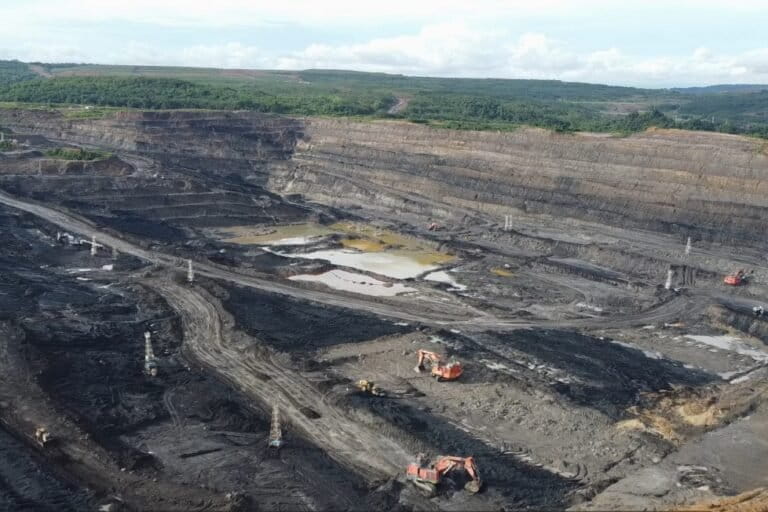
He explained that methane measurement is easier in underground mines due to ventilation systems. In contrast, in open-pit mines, methane is directly released into the atmosphere when coal seams are exposed, making detailed measurement difficult.
The problem is that most mining operations in Indonesia use open-pit methods. “It is not easy for companies to calculate this in detail.”
Additionally, methane emissions depend heavily on geological characteristics, coal seam depth, gas pressure within the rock, and geological structures. As a result, two mines with the same production levels may not produce the same methane emissions due to these differences.
Accurate calculation requires specialized equipment and regular testing, including additional drilling to verify primary data—leading to significant additional costs.
“So it is very difficult.”
The Ministry of Energy and Mineral Resources (KESDM), he added, will continue updating regulations to accelerate progress toward emissions-reduction targets. Regarding data integration, the first phase of emissions integration has been completed in several companies.
However, EITI and PWYP argue that this is not enough. If Indonesia is serious about achieving net zero by 2060, the government must address these issues at their root. In addition to improving data transparency, Indonesia must gradually reduce coal production.
 Real Solutions
The energy sector is the largest contributor to emissions globally and nationally. In Indonesia, it accounts for around 43% of the country’s total emissions, with coal as the main contributor.
Indonesia was recorded as the third-largest coal producer in the world in 2023. Production even increased by 110.99%—a trend that contradicts emissions reduction targets.
“Coal production contributes to the increase of one greenhouse gas, methane,” Astrid said.
Muhammad Adzkia Farirahman, a researcher at PWYP, stated that peak CO₂ emissions from power plants are expected to occur in 2037, reaching around 599 million tons of CO₂. This consists of approximately 433 million tons from grid emissions and 166 million tons from captive power emissions.
He urged the government to take energy transition efforts more seriously. These emissions figures, he emphasized, are not merely technical targets but a mandate to ensure quality of life for present and future generations.
Stronger oversight is also needed to break coal dependency and avoid false solutions that could create new problems.
“As the sector contributing the most [to emissions increases], the coal industry requires a specific strategy for decarbonization.”
Source: Mongabay