


PWYP Indonesia, with support from the European Union and the Open Government Partnership, held a consolidation meeting with civil society organizations (CSOs) implementing the national action plan to discuss preparations for the B-06 monitoring and evaluation (Monev) report for RAN OGI VIII for the 2026–2027 period. The meeting was held in hybrid format from the PWYP Indonesia office on 29 June 2026. The discussion aimed to review achievements, constraints, and challenges for each commitment and working group in the action plan. CSO representatives in attendance included IJRS, Wahana Visi Indonesia, Solar Chapter, CISDI, YAPIKA, Penabulu, Human Initiative, SAPDA, PATTIRO, KOPEL, Yayasan Nusantara Sejati, and several other CSOs.
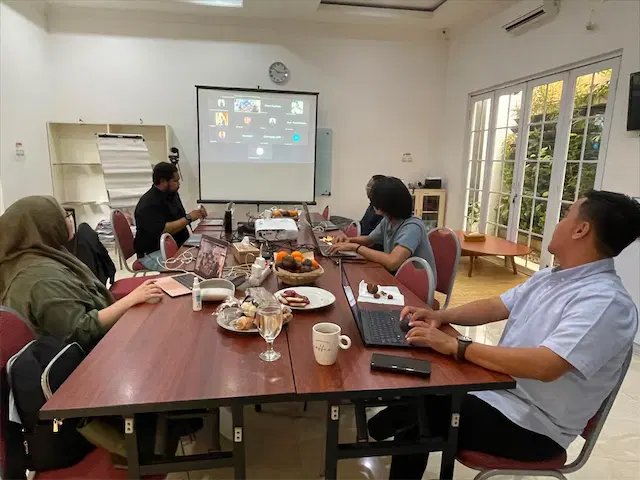
The forum opened with a presentation by IJRS on the RAN OGI Monev mechanism and reporting procedures, followed by a reflection session on the implementation of commitments over the six-month period. The discussion covered progress in co-creation with ministries and agencies (K/L) and the challenges or constraints encountered. It illustrated two things at once: collaboration between government and civil society that has begun to take shape across many sectors, and, on the other hand, a sense that the monitoring and evaluation mechanism in this first semester remains too administrative.
Reflection on Commitment Implementation
Junito Drias of Wahana Visi Indonesia (WVI) described his involvement in several RAN OGI VIII commitments, particularly those related to monitoring and evaluation of child policy together with the Indonesian Child Protection Commission (KPAI). This commitment has reached the stage of drafting guidelines that lead toward a children’s version of the citizen scorecard, or children scorecard. Drias also noted that implementation had faced some coordination constraints, because at the time KPAI was focused on reorganization; however, KPAI is now open to co-creation.
Aini, representing Solar Chapter as the CSO leading the commitment on improving access to clean water and sanitation (WASH) in three priority districts in East Nusa Tenggara, also reported on implementation progress. She explained that in this B06 the commitment focuses on data collection. Outreach in the three new locus areas had only been carried out one week earlier. On the positive side, local governments appeared enthusiastic about the activities and even helped map supporting factors, acceleration mechanisms, and barriers; the results are now being finalized by the team from the Ministry of Villages.
There had previously been constraints related to official correspondence and the legal basis for conducting outreach in the regions, but after an official letter and clarification were obtained from the OGI National Secretariat, outreach in the three NTT locus area could proceed. Drias, representing WVI, which is also involved in this commitment together with Solar Chapter, had likewise raised the issue of the still-weak legal basis for implementing RAN OGI, which could make it difficult for the NTT Bappeda and the Ministry of Villages to support the commitment.
Legal Basis and Reporting Mechanism
Responding to the legal basis issue, Yoris of IJRS explained that the applicable legal basis is Decree of the Minister of National Development Planning/Head of Bappenas Number 55 of 2025, which replaces Ministerial Decree Number 88 of 2018. Both regulate the OGI Strategic Coordination Team, including the involvement of the Ministry of Home Affairs, the Ministry of Administrative and Bureaucratic Reform, the Ministry of Foreign Affairs, and CSO representatives on the steering committee. Nevertheless, the decree does not regulate the technical aspects of governance, implementation, and monitoring and evaluation of the RAN. For that reason, according to Yoris, the legal basis is not yet strong enough when presented to local governments or other stakeholders, although it remains appropriate to cite.
Yoris also shared the results of the Monev socialization conducted by the OGI National Secretariat. An important finding was that many planning bureaus in ministries and agencies were not yet aware of the obligation to report on RAN OGI. Yet it is the planning bureaus that hold the reporting accounts for ministries and agencies, while the substantive implementers of commitments sit in technical units. He therefore suggested that CSOs coordinate not only with technical units, but also inform the planning bureaus of their partners. CSOs themselves report through the system on the OGI National Secretariat website, with accounts held only by the person in charge (PIC) of each commitment. After reporting, the National Secretariat assesses co-creation using three colors: green for active, yellow for semi-active, and red for passive. The results are then verified in the Multi-Stakeholder Forum (MSF).
SAPDA also explained its commitment and collaboration with the Planning Bureau of the Supreme Court on court accessibility for persons with disabilities. The two parties are currently drafting a monitoring tool that will then be piloted in one to four court work units. Sapda assessed communication with the Supreme Court as good, but for the Monev report they are still discussing the matter internally because this is their first experience of being involved in RAN OGI.
Ensuring Monev Does Not Stop at Administration
Beyond the substantive and administrative issues of the commitments, one CSO representative also raised the constraint of the reporting deadline, which was felt to require an extension. It is hoped that through this meeting the request can be forwarded to the OGI Secretariat to extend the reporting period for this B06 Monev. The meeting closed with a summary of follow-up plans that need to be confirmed with the OGI National Secretariat, such as the interpretation of supporting data and the reporting deadline. The meeting also recalled that the stage after this B06 Monev reporting is a multi-stakeholder meeting that will serve as a space for validation, clarification, and assessment of co-creation between CSOs and the relevant ministries and agencies. This is important to ensure that the work of implementing the action plan does not stop at collecting administrative documents.