


Lombok — For the people of Karang Sidemen Village, Batukliang Utara Subdistrict, Central Lombok Regency, the approximately 182 hectares of land managed by 520 households is more than just a stretch of land. For years, the land has been an integral part of the community’s living space and source of livelihoods through farming and plantation activities.
However, this living space is facing growing pressure. One of the pressures comes from the expansion of non-metallic mineral mining, commonly known as galian C, around the village.
For the community, these activities have the potential to put pressure on upstream areas, springs, water catchment zones, and productive agricultural land that has long supported local livelihoods.
The issue is not merely about the existence of mining activities, but about how natural resources are managed and who gets to determine the future of the community’s living space.
The rapid expansion of non-metallic mineral mining, or galian C, in areas that the community considers ecologically sensitive has raised concerns about potential threats to the ecological functions of the landscape, particularly water catchment areas and productive agricultural land.
If not managed carefully, changes to the landscape can have broader consequences, ranging from the decline of the area’s hydrological functions to increased community vulnerability to environmental and climate-related risks.
In this context, according to the community, land governance cannot be separated from the climate justice agenda. Communities whose livelihoods depend on land, water, forests, and agriculture are among those most reliant on healthy and sustainable ecosystems.
When the ecological functions of an area come under pressure, local communities are often among the first to experience the impacts, while the economic benefits generated from resource exploitation may not necessarily be distributed fairly.
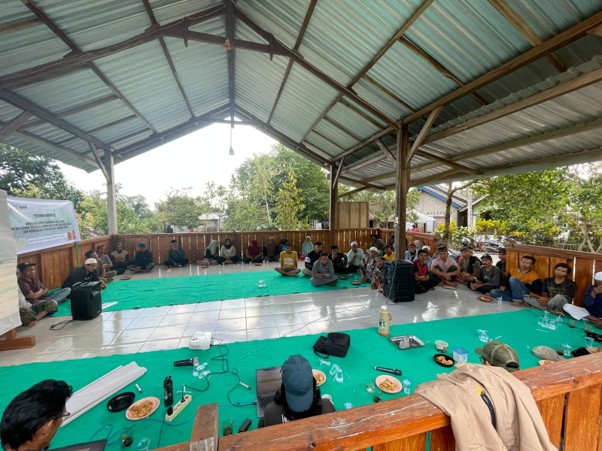
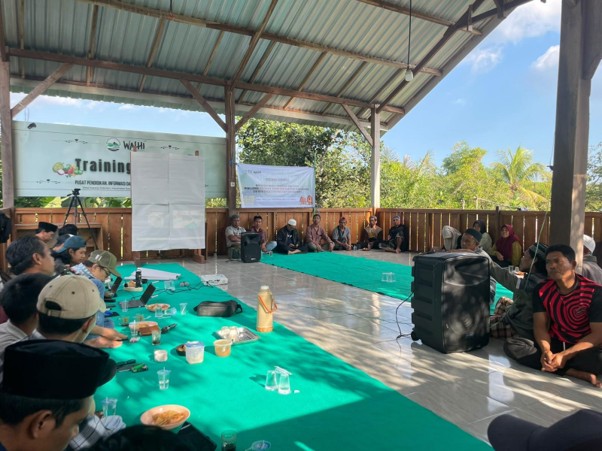
This concern has motivated members of the LMDH Lestari Rinjani Community to organize a village meeting as an initiative to discuss and respond to the challenges facing the village.
The meeting is not intended to close off development opportunities, but rather to ensure that development does not come at the expense of ecological functions, living spaces, and community livelihoods.
Held on 7 August 2026, the meeting sought to strengthen community-managed spaces through agrarian reform, collective land management, and protection of community areas from extractive activities.
This initiative forms part of broader efforts to protect community-managed territories and prevent the expansion of extractive industries that threaten the landscapes of West Nusa Tenggara (NTB), particularly in village areas.
182 Hectares for 520 Families
One of the key issues discussed was the community’s push to secure legal certainty and recognition for the 182 hectares of land managed by 520 households through the Tanah Objek Reforma Agraria (TORA) scheme, or Land Objects for Agrarian Reform.
For the community, the land holds strategic value for the sustainability of local livelihoods. The push for recognition through the TORA scheme is therefore seen as an important step toward securing tenure and management rights over the land—one of the key foundations for protecting their living space.
The community plans to manage the land collectively through community institutions, with ownership or control structured on an organizational or communal basis. In this way, the land can be managed jointly for the collective welfare of the community.
At the same time, the community is urging the Karang Sidemen Village Government not to open the way for galian C activities that could threaten the ecological functions of upstream areas and the sustainability of local agricultural land.
This is part of an effort to protect the village area from the rapid expansion of mining activities. The community recognizes that mining can alter landscapes, particularly in areas with important ecological functions, potentially affecting the environment’s capacity to absorb and store water.
In upstream areas, this issue is even more critical, as changes in land cover and land structure can have implications for broader hydrological systems.
From a climate perspective, ecosystem damage or degradation can also increase community vulnerability to various risks. Changes in rainfall patterns, increasing extreme rainfall events, drought, and disruptions to water availability can become more difficult to cope with when the capacity of ecosystems to support communities declines.
Therefore, the village meeting organized by the LMDH Lestari Rinjani Community represents an approach to strengthening the community’s position as a key actor in protecting its living space while advancing natural resource governance that is environmentally sustainable and socially just—even if the initiative begins on the relatively small scale of a village.
Overall, the meeting provided an important space to identify problems and formulate collective actions as part of the community’s initiative to strengthen community-managed areas. The meeting resulted in several key points:
- Promote a land management scheme for farmers through the Tanah Objek Reforma Agraria (TORA) mechanism, covering 182 hectares of land managed by 520 households, in accordance with Presidential Regulation No. 86 of 2018 on Agrarian Reform and Presidential Regulation No. 62 of 2023 on the Acceleration of Agrarian Reform Implementation.
- Manage the land collectively.
- Establish land ownership under the name of a community organization or through communal land certificates.
- Urge the village government not to issue domicile recommendation letters, location legitimacy letters, or preliminary administrative endorsements at the village level for applications for galian C mining permits or other mining activities.
- Urge the village government to assist and support the development of community-managed areas to improve local economic welfare.
Written by: Ariyansah NK & WALHI NTB
Reviewed by: Meliana Lumbantoruan