


Jakarta – In the activity “From Our Stories, the Growing Movement, Youth Feminist Disability Training 2026” organized by the Indonesian Women with Disabilities Association (HWDI) on 19 May 2026, Wicitra D. from PWYP Indonesia had the opportunity to serve as a resource speaker in the session “If the Earth Changes, Who is Most Affected?”. The forum was specifically for participants with disabilities from across Indonesia, ranging from Aceh, West Nusa Tenggara, Sulawesi, and Central Kalimantan to various other provinces.
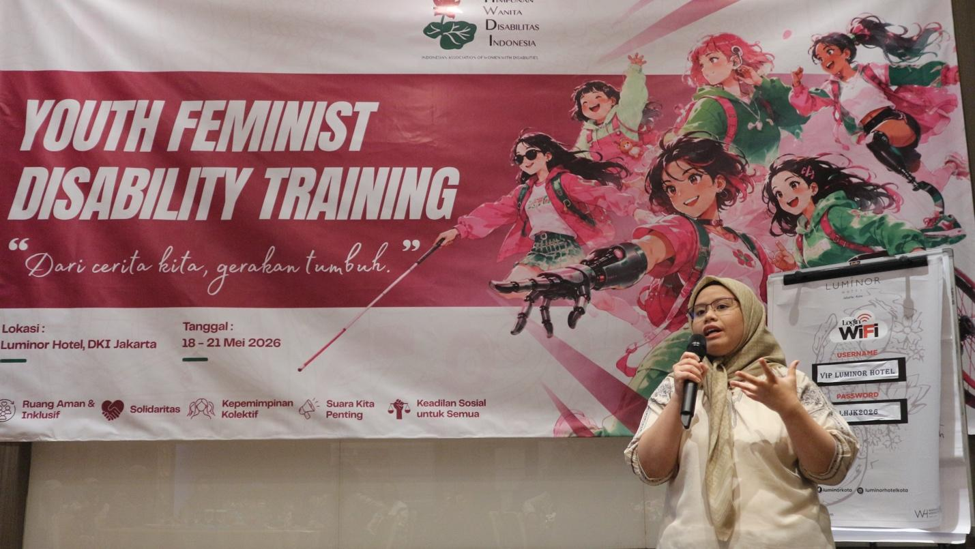 In the session, Wicitra provided a comprehensive explanation of climate change, covering its processes, causes, impacts, as well as the adaptation and mitigation measures that must be taken. She explained that climate change can occur naturally, for instance through volcanic eruptions and variations in solar radiation. However, increasingly massive human activities have become the main driver accelerating climate change today. Naturally, the greenhouse effect is essential to prevent Earth’s temperature from dropping to -18°C (BMKG, 2025). Unfortunately, human actions have caused global temperatures to rise to 1.1 °C, the highest level recorded during the 2011–2020 decade, compared to the 1800s when temperatures were still around 0°C (UN Indonesia, no year).
One of the primary causes is the burning of fossil fuels such as coal, oil, and gas, which generates excessive greenhouse gas (GHG) emissions and drives continuous temperature increases. In the energy sector, for example, combustion at Coal-Fired Steam Power Plants (PLTU) releases large amounts of carbon dioxide, while coal mining operations also emit methane gas into the atmosphere.
The Paris Agreement sets a target to limit global temperature rise to below 1.5°C. To achieve this, two main approaches must be pursued simultaneously: adaptation and mitigation. Adaptation involves actions to reduce vulnerability and the impacts of climate change, such as natural disasters and biodiversity loss, for example, by planting trees and strengthening early warning disaster systems. Mitigation, on the other hand, refers to efforts to reduce GHG concentrations in the atmosphere, including through energy transition, forest conservation, and energy efficiency.
Wicitra also addressed the justice dimension of the climate crisis. Citing Ruang Kota (2025) as reported by Madani, she emphasized that the impacts of the climate crisis are not evenly distributed. Certain groups bear a significantly heavier burden due to limited capacity to carry out mitigation. For instance, during floods or natural disasters, informal sector workers are among the most vulnerable. This is highly relevant to the situation of persons with disabilities: out of 17 million working-age persons with disabilities in Indonesia, only 0.55% are employed in the formal sector (BPS, 2023; KonekIndonesia, 2025).
Furthermore, Wicitra highlighted the importance of ensuring the energy transition is “just” as part of climate adaptation efforts. She posed three fundamental questions that must be answered: justice for whom, how can the process be considered fair, and what form should the distribution of justice take? Integrating justice principles into the energy transition is crucial to correct the old pattern of destructive mining extractivism that has often ignored vulnerable groups, especially persons with disabilities. Indicators of this problem include the lack of official data on persons with disabilities affected by mining, the near-absence of employment opportunity data for disability groups, and the clean water crisis in mining areas that disproportionately burdens vulnerable groups, including women and persons with disabilities.
Wicitra also pointed out several inclusivity challenges in energy sector regulations. One example is Government Regulation (PP) No. 40/2025 on the National Energy Policy (KEN), a revision of the 2014 policy that serves as the latest legal framework for national energy policy. Findings from a PWYP Indonesia study (2026) show that the new KEN has not explicitly integrated inclusive principles and remains largely normative. Moreover, the policy does not provide participation mechanisms for vulnerable groups such as persons with disabilities, nor does it mandate the collection of disaggregated data for these groups.
This situation reflects a deeper problem: disability-related regulations in Indonesia have remained segregative and have not adopted a universal design approach. Yet urgent change is needed. In practice, persons with disabilities are the group least involved in decision-making forums, a reality closely linked to the scarcity of disaggregated data. Disaggregated data is a fundamental prerequisite for building genuinely inclusive forums, as it enables the mapping and identification of which vulnerable groups must be included in decision-making processes.
At the end of the session, Wicitra shared practical daily actions that persons with disabilities can take to help curb climate change, such as conserving energy at home, saving water, adopting environmentally friendly consumption patterns, and reducing transportation-related emissions. She also conveyed PWYP Indonesia’s advocacy commitment to integrating Gender, Equality, Disability and Social Inclusion (GEDSI) principles into the energy transition agenda and climate action. Since 2023, PWYP has actively developed various GEDSI studies while monitoring the revision of the KEN and the National/Regional General Energy Plans (RUEN and RUED). PWYP also advocates for inclusive leadership in the 2025 selection process for the National Energy Council (DEN) and has produced various relevant campaign materials themed around inclusivity.
Author: Wicitra D.
Reviewer: Mouna Wasef