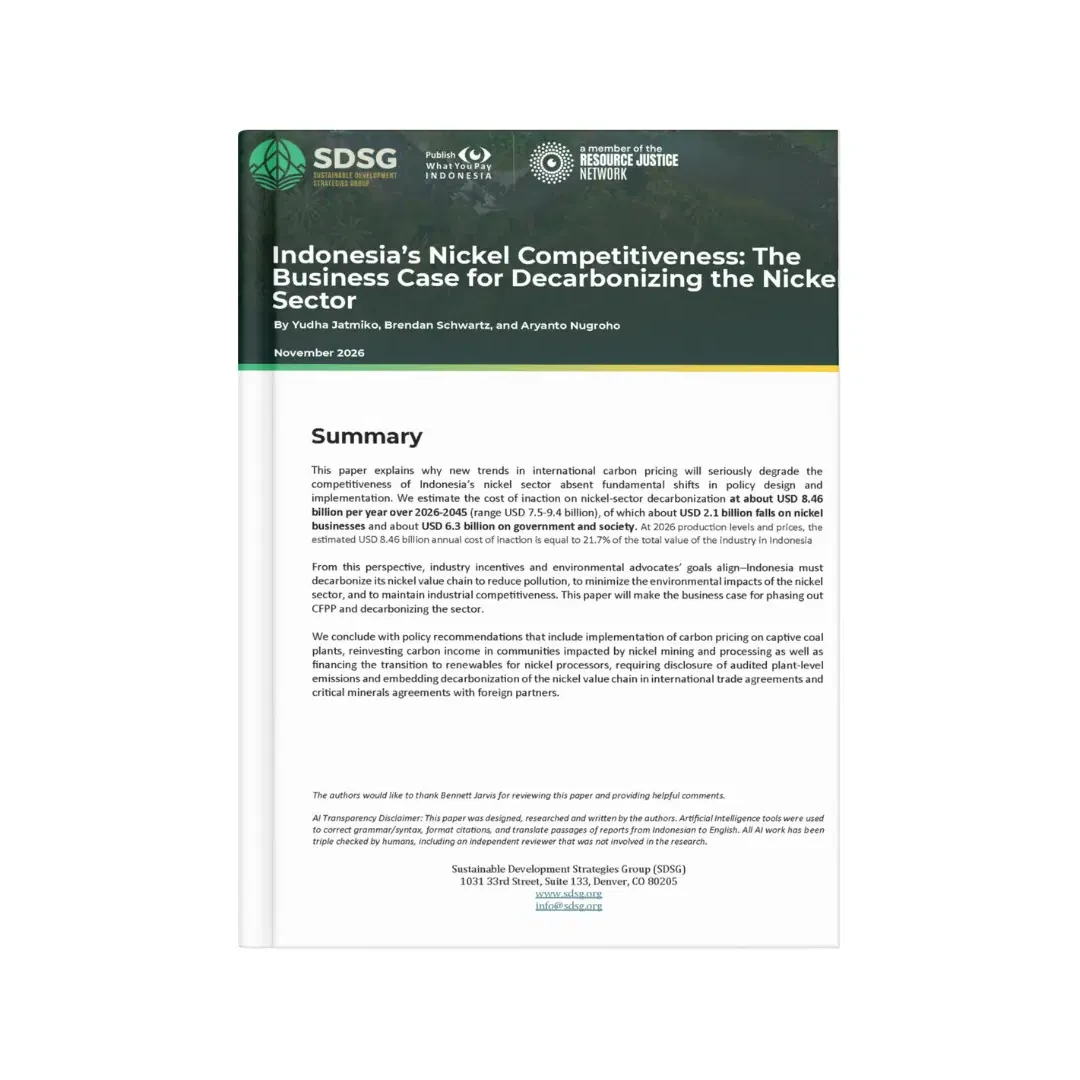
PWYP Indonesia and SDSG are pleased to release our new paper “Indonesia’s Nickel Competitiveness: The Business Case for Decarbonizing the Nickel Sector”
Indonesia has pursued a value-added agenda in the nickel sector, which has led to a rapid rise in industrial parks dedicated to nickel processing, almost entirely powered by captive coal-fired power plants (CFPP). Yet the rapid expansion of the sector has outpaced Indonesia’s state capacity to regulate it effectively, leading to serious social and environmental harms. Civil society organizations, including members of Publish What You Pay (PWYP) Indonesia, have documented labor rights violations, deforestation, displacement of communities, air and water pollution, and a lack of mine site reclamation. Despite these challenges, the government continues to facilitate investment in new nickel mines and processing facilities, and offtakers largely continue to accept Indonesian nickel in their supply chains.
Rather than focusing on the social and environmental impacts of nickel mining and processing, our paper explains why new trends in international carbon pricing will seriously degrade the competitiveness of Indonesia’s nickel sector absent fundamental shifts in policy design and implementation.
Key findings:
- We estimate the cost of inaction on nickel-sector decarbonization at about USD 8.46 billion per year over 2026-2045 (range USD 7.5-9.4 billion): about USD 2.1 billion for nickel businesses and about USD 6.3 billion for government and society. At 2026 production levels and prices, this equals 21.7% of the total value of Indonesia’s nickel industry. About 60% of the total is the estimated value of foregone carbon-market revenue rather than a cash cost to business.
- The carbon gap is the root cause: RKEF nickel emits 92.9 tCO₂e per tonne of nickel, roughly eight to nine times HPAL (10.8). Captive coal power emitted 107 million tCO₂e in 2023, part of a sector total that is seventeen-fold higher than in 2013.
What we recommend:
- Price captive coal carbon now: a BPDLH-channeled levy rising from USD 5/tCO₂e in 2027 to USD 100 in 2035, designed to count as a carbon price under EU CBAM Article 9, so it can be deducted rather than paid again at the EU border.
- Make facility-level emissions reporting mandatory, independently verified and public.
- Return part of the levy revenue to Morowali, Weda Bay and Konawe for health services, air quality monitoring and land and water remediation, where the costs fall.
- Stop subsidizing the problem: no new captive coal, and phase out fossil fuel subsidies.