Indonesia has made notable progress in advancing open government through the Open Government Indonesia (OGI) initiative. However, ensuring its long-term effectiveness and sustainability requires further strengthening of institutional foundations, particularly in terms of legal frameworks, cross-sectoral coordination, and consistent, inclusive accountability mechanisms.
In response to this need, PWYP Indonesia has initiated a strategic effort aimed at reinforcing the institutional foundation of OGI. This initiative seeks to bridge the gap between existing formal arrangements and their practical implementation, which still requires further consolidation. In the broader perspective, this effort contributes to building a more robust, coordinated, and sustainable open government ecosystem in Indonesia.
The approach integrates several key dimensions. First, it focuses on strengthening the policy foundation through the development of a strategic document that provides evidence-based justification for enhancing the legal framework of OGI. This document is expected to serve as a reference for policymakers in shaping a more structured and long-term institutional reform pathway.
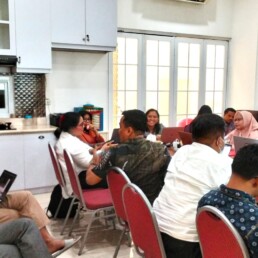
Second, the initiative supports the strengthening of the Multi-Stakeholder Forum (MSF) as a central platform for collaboration between government and civil society. Through more structured facilitation and improved governance of thematic working groups, this effort aims to enhance the quality of co-creation processes, ensuring they are more meaningful, inclusive, and implementation-oriented.
In parallel, the project actively expands the scope of civil society engagement within the OGP agenda. This includes reaching out to new actors, such as regional CSOs, youth groups, and disability organizations, while also re-engaging existing partners. By broadening participation, the initiative seeks to foster a more inclusive and representative OGP ecosystem, enabling a wider range of perspectives to inform policy development and implementation.
Third, the initiative provides substantive support to the development of the monitoring and evaluation (M&E) framework, particularly by contributing inputs from civil society and the multi-stakeholder forum. This approach aims to ensure that the M&E framework is not only technically sound but also reflective of cross-sectoral coordination needs, supportive of transparency, and conducive to shared learning throughout the implementation of the OGP National Action Plan.
Strategically, this initiative goes beyond delivering short-term outputs. It contributes to strengthening the overall system by reinforcing the linkages between policy, coordination, and accountability, while also expanding the base of civil society participation. In doing so, it helps create the conditions for more effective governance and fosters greater trust among stakeholders.
With its experience in promoting transparency and accountability, PWYP Indonesia plays a key role as a facilitator and bridge between government and civil society actors. This approach ensures that reform processes remain inclusive while being grounded in a foundation that can sustain progress beyond the duration of the initiative.
Looking ahead, the strategic value of this effort lies in its focus on strengthening existing systems, allowing its results to be sustained and further developed over time. As such, the initiative contributes to long-term efforts to institutionalize open, participatory, and accountable governance in Indonesia.