


The management of mines by cooperatives has sparked controversy, it could serve as a tool for economic redistribution, but also risks being co-opted by major investors.
The Desa Merah Putih Cooperative is set to become increasingly expansive after gaining the green light to manage mineral and coal mining operations. Under Government Regulation No. 39 of 2025 on the Implementation of Mineral and Coal Mining Business Activities, issued on September 11, 2025, cooperatives and small and medium enterprises (SMEs) are allowed to manage mining areas of up to 2,500 hectares.
The government stipulates that cooperatives can obtain Mining Business License Areas (WIUP) through a priority allocation scheme, provided they meet the administrative and membership criteria. As outlined in Article 26C of Government Regulation No. 39/2025, verification of these criteria will be conducted by the minister responsible for cooperative affairs.
According to Minister of Cooperatives Ferry Juliantono, the new regulation is a breakthrough intended to ensure that mining operations are no longer dominated by large corporations. “This policy is expected to generate greater economic impact for local communities, especially in regions with significant mining potential,” he said in a written statement on October 7, 2025.
Ferry also expressed hope that managing mining operations through the Desa Merah Putih Cooperative could help prevent mining-related conflicts in local areas. In line with this, he voiced support for allowing the cooperative to manage tin mining permits in Bangka Belitung. This means that small-scale miners must join the cooperative in order to obtain legal status for their mining activities. Ferry made this statement in response to a protest by local tin miners at the headquarters of PT Timah Tbk in Bangka Belitung on October 6–7, 2025, which ended in unrest.
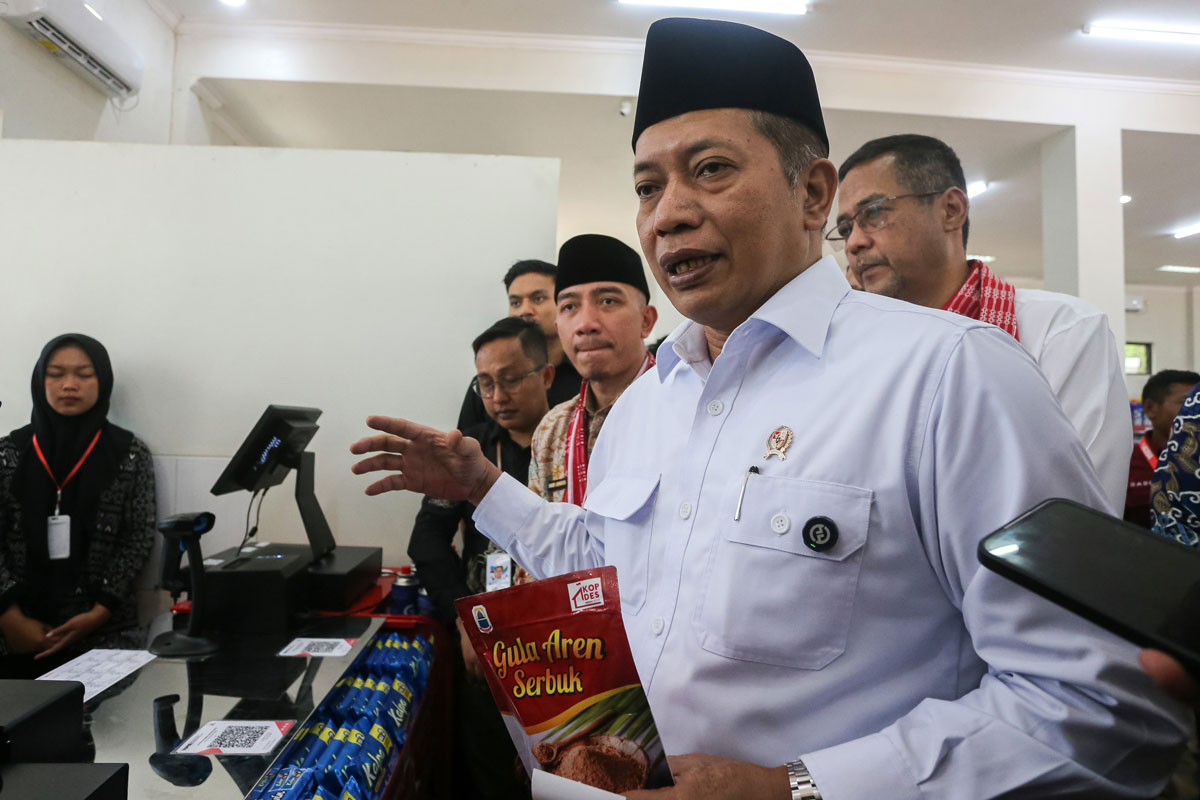
When met at the Presidential Palace Complex in Central Jakarta on October 8, 2025, Minister of Energy and Mineral Resources Bahlil Lahadalia said that the government is still drafting a ministerial regulation outlining the criteria for cooperatives and SMEs eligible to manage mining operations. According to him, only cooperatives or business entities located within the mining area should be allowed to operate there. “For example, SMEs and cooperatives in North Kalimantan can manage mines in North Kalimantan. Not those based in Jakarta…,” he said.
However, Publish What You Pay (PWYP) Indonesia National Coordinator Aryanto Nugroho questioned the government’s urgency in granting mining permits to cooperatives. He argued that Government Regulation (PP) No. 39 of 2025 was issued to accommodate the Desa Merah Putih Cooperative as part of President Prabowo Subianto’s priority programs. “We suspect this is a red carpet for that entity,” he said on Thursday, October 9, 2025.
Although the issuance of mining permits for cooperatives may be well-intentioned, Aryanto warned of the risks of cooperative-led mining, especially when the cooperatives lack technical expertise. He pointed out several potential problems — including workplace accidents, environmental damage, corruption, and social conflict. Managing a mine through a cooperative, he added, also carries a high risk of failure due to the substantial capital required, potentially harming cooperative members financially.
Who Gets How Much
Government Regulation No. 39 of 2025 on the Implementation of Mineral and Coal Mining Business Activities defines the maximum area of Mining Business License Areas (WIUP) allocated to different groups, with a minimum concession size of 2,500 hectares.
WIUP allocation for cooperatives and SMEs:
- Up to 2,500 hectares for metal mineral or coal mining areas
For enterprises owned by religious mass organizations:
- Up to 25,000 hectares for metal mineral WIUPs, or 15,000 hectares for coal WIUPs
For state-owned enterprises (BUMN), regional-owned enterprises (BUMD), and private companies cooperating with universities:
- Up to 25,000 hectares for metal mineral WIUPs, or 15,000 hectares for coal WIUPs
For state-owned enterprises and private companies engaged in downstream industries:
- Up to 25,000 hectares for metal mineral WIUPs, or 15,000 hectares for coal WIUPs
Source: Article 26F of Government Regulation No. 39 of 2025
Wishnu Try Utomo, Director of Mining Advocacy at the Center of Economic and Law Studies (CELIOS), also said there is no urgency to grant mining licenses to cooperatives. In his view, the policy shows that the government fails to grasp the real issues in the mining sector. The government, he argued, still has not resolved post-mining environmental restoration. “It will be risky if mining permits are granted to more players, such as cooperatives,” he said.
Wishnu expressed concern that responsibility for environmental rehabilitation would be increasingly neglected if mining operations are managed by smaller business entities, given the high costs involved. He also warned that large companies could exploit cooperatives to expand their mining concessions — “to have more legs,” as he put it.
Safety concerns are another major risk. Wishnu emphasized that mining operations require specialized expertise and strict occupational safety standards, while cooperatives’ capacity in these areas remains unproven. He cited a tragic example: a landslide at a sand mine operated by the Al-Azariyah Islamic Boarding School Cooperative in Mount Kuda, Cirebon Regency, West Java, in June 2025, which claimed 21 lives.
Meanwhile, Resvani, Deputy Chairperson of the Indonesian Mining Experts Association (Perhimpunan Ahli Pertambangan Indonesia / PERHAPI), said that granting mining permits to cooperatives could serve as a tool for wealth distribution to local regions. However, he emphasized that the risks must be minimized, for instance by not granting permits for high-risk mining operations, such as underground mining.
Resvani also urged the government to tighten technical requirements to reduce the risks of accidents and environmental damage. The same caution, he said, should apply to funding mechanisms, since mining activities require large-scale investment due to their lengthy and complex processes — especially given that the government allows WIUP allocations of up to 2,500 hectares.
“The investment required is enormous,” he remarked.