


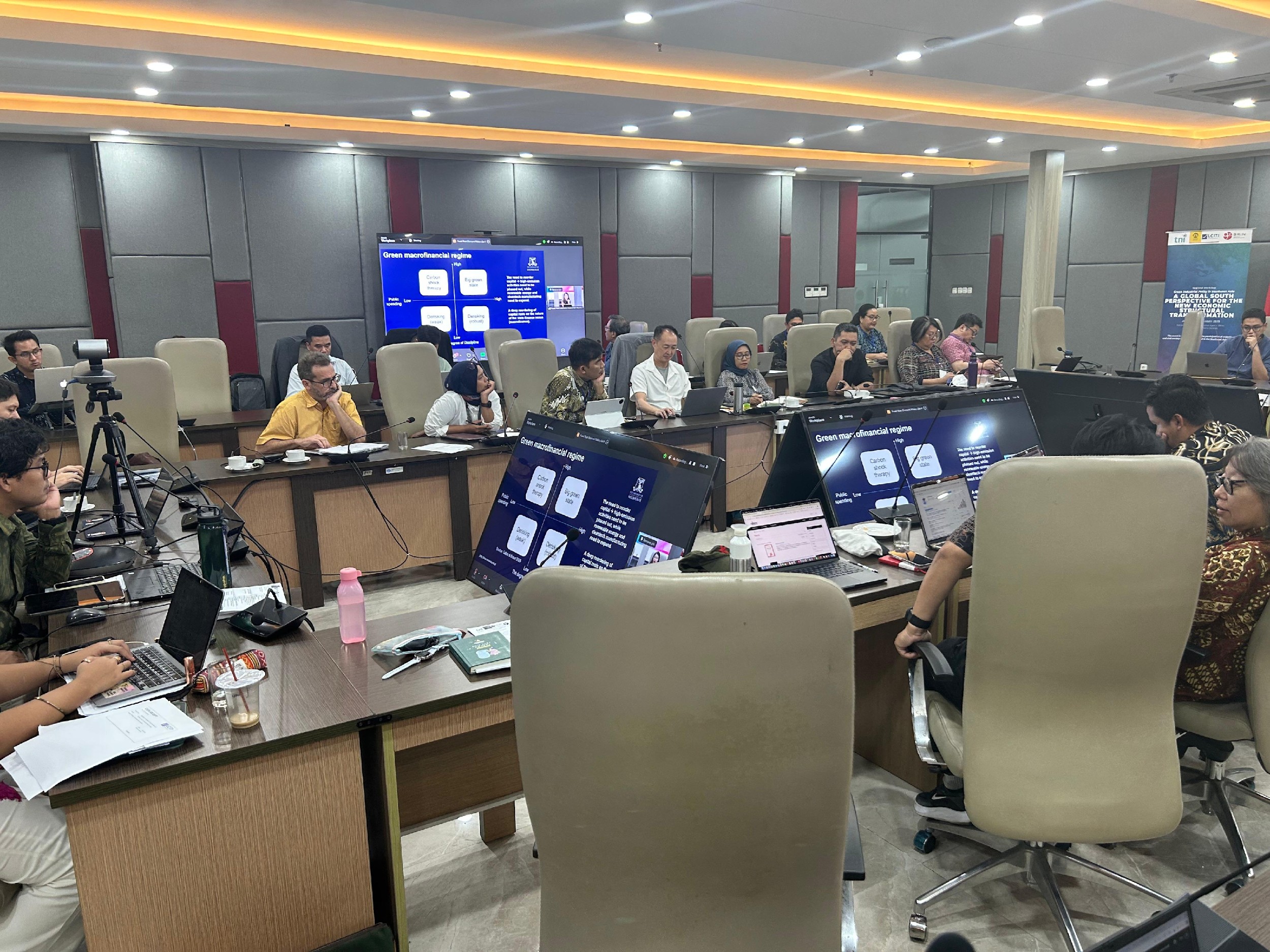
Jakarta, August 26, 2025 – Publish What You Pay (PWYP) Indonesia participated in the Regional Workshop: “A Global South Perspective for the New Economic Structural Transformation” organized by the Transnational Institute (TNI), The Legal Center for International Trade and Investment (LCITI) at the Faculty of Law, University of Indonesia, and the Research Center for Macroeconomics and Finance – BRIN. This event, held in Jakarta, brought together academics, researchers, labor unions, and civil society organizations from Southeast Asia to discuss directions for fair, green, and democratic economic development for Global South countries.
In the critical reflection session discussing issues of Labor and Just Energy Transition, Meliana Lumbantoruan, Deputy Director of PWYP Indonesia, appeared as one of the speakers. She reminded that Indonesia’s position as the country with the second-largest nickel reserves in the world is often seen as a great opportunity. Still, in reality, it leaves many issues of injustice. “Abundance does not equal justice. The question is always: who benefits, who bears the costs, and whose voice is not heard,” she said.
In her reflection, Meliana emphasized that three main aspects must be prioritized if Indonesia wants to achieve a just energy transition. The first is governance. With more than 4,400 mining permits supervised by only 492 inspectors, the control mechanisms are highly imbalanced. This gap often leads companies to overlook their obligations. Data from the Corruption Eradication Commission (KPK) in 2022 even showed that 70 percent of mining companies did not pay reclamation and post-mining funds. As a result, environmental damage worsens, and social conflicts at the local level are hard to avoid.
The second is justice in resource management. Nickel export policies that change frequently encourage excessive extraction, while the economic benefits are not evenly distributed. In Morowali, for example, the nickel industry has indeed grown rapidly; however, its contribution to the local government is only around 2.34 percent (Rp 215.6 billion). This amount is tiny compared to the social-ecological losses borne by local communities, ranging from the loss of agricultural land to declining quality of life. “When economic benefits are concentrated in the center, while producing regions bear the environmental and social burdens, what happens is not development, but the reproduction of injustice,” she explained.
The third aspect is justice for workers and energy. In the field, laborers still face inadequate working conditions: long working hours, minimal protection, and wage disparities between local and foreign workers. At the same time, smelters touted as part of green industrialization still rely on coal-fired power plants (PLTU). Between 2015 and 2022, PLTU capacity increased by 13 gigawatts just to support the nickel industry, an evident paradox that contradicts the Net Zero 2060 commitment. “Green industrialisation must not be built on brown practices. If the green industry is still supported by coal, then this transition is merely cosmetic, not a solution,” she stated.
Closing her reflection, it was emphasized that justice must be at the core of green industrialization—justice for workers, local communities, and the climate. The way forward includes investments in research and technology transfer, transitioning smelters to renewable energy before 2030, enforcing decent work standards and the right to unionize, and implementing progressive fiscal policies so that economic benefits can be shared more fairly. “Without reforms that side with the people, Indonesia will only repeat old patterns: rich in resources, but poor in justice,” Meliana concluded.
PWYP Indonesia’s presence in this forum strengthens the voice of civil society that energy transition must not only follow global market logic. Moreover, the transition must be a momentum to ensure people’s welfare, protect the environment, and foster sustainable economic sovereignty.
Writer: Meliana Lumbantoruan