


- The Publish What You Pay (PWYP) Indonesia – Sumatra Regional Coalition urges the central and regional governments to immediately impose a moratorium on mining permits across the entire island of Sumatra.
- According to data from the Ministry of Energy and Mineral Resources (MEMR/ESDM), about one-third of Indonesia’s national coal reserves, equivalent to 11,866.66 million tons (37.34 percent), are located in Sumatra. However, this wealth has instead triggered ecological crises and intensified social conflicts at the local level.
- Data from the Aceh MEMR Office as of June 2025 shows that 64 mining business permits (IUP) remain active, consisting of 28 production operation permits and 36 exploration permits. Most of them show no real activity on the ground. GeRAK has recorded that this “idle IUP” phenomenon has persisted since 2014.
- Corrupt practices in permit issuance tend to increase ahead of regional leadership transitions. Based on data from GeRAK and the 2024 Aceh Provincial Legislative Mining Committee (Pansus Tambang DPRA), the number of newly issued IUPs consistently spikes near the end of a governor’s term.
Several civil society organizations under the Publish What You Pay (PWYP) Indonesia – Sumatra Regional Coalition are urging the central and regional governments to impose an immediate moratorium on mining permits across Sumatra.
The call was delivered during a media discussion titled “The Urgency of a Mining Permit Moratorium: Encouraging Improved Oversight of Mineral and Coal (Minerba) Governance and Crackdowns on Illegal Mining in Sumatra,” held in Banda Aceh on Wednesday (29/10/2025).
According to the coalition, Sumatra is a region rich in natural resources, especially coal. Based on data from the Ministry of Energy and Mineral Resources (ESDM), about one-third of Indonesia’s national coal reserves, equivalent to 11,866.66 million tons (37.34 percent), are found in Sumatra. However, this wealth has instead resulted in ecological crises and heightened social conflict at the local level.
Munawir, Member of the Working Body of MaTA Aceh, highlighted the failure of the mining sector to deliver significant fiscal contributions.
“Many companies do not comply with tax obligations, while the ecological losses are enormous. A moratorium and a full review of all mining business permits (IUP) are not optional—they are an obligation to stop violations and ensure justice for the people of Aceh.”
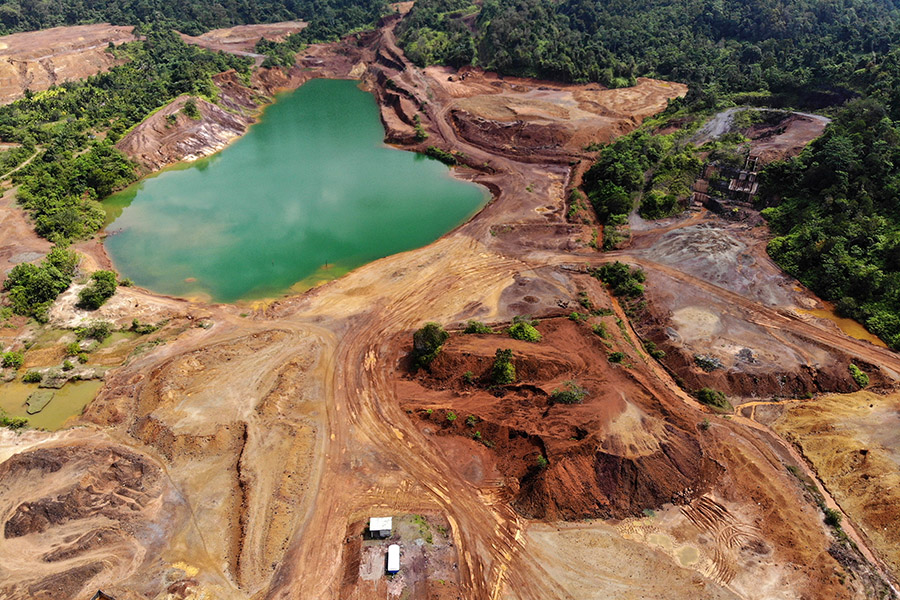
Fernan, Head of the Public Policy Division at the Anti-Corruption Movement (GeRAK) Aceh, stated that mineral and coal (minerba) governance in Aceh remains far removed from principles of transparency and accountability.
“There are IUPs with production operation status, but with no activity at all. This is a legal violation and potentially harmful to the state.”
Data from the Aceh MEMR Office as of June 2025 shows 64 active IUPs, consisting of 28 production operation permits and 36 exploration permits. Most show no real activity on the ground. GeRAK has noted that the “idle IUP” phenomenon has persisted since 2014.
“Mining licenses are often used as instruments for financial transactions such as collateral for financing or increasing share value, without any actual production. They are not being used as tools for resource extraction.”
Corrupt practices around permit issuance tend to escalate ahead of regional leadership transitions. According to data from GeRAK and the 2024 DPRA Mining Committee, the number of new IUPs consistently surges near the end of a governor’s term.
During the tenure of Aceh Governor Zaini Abdullah (2012–2017), four new IUPs were issued, increasing to seven under Irwandi Yusuf (2017–2018). Under Nova Iriansyah (2018–2022), the number rose to 10. During Acting Governor Ahmad Marzuki’s term (2022–2024), 12 new permits were issued, and under Acting Governor Bustami Hamzah in 2024, nine more IUPs were added.
“The pattern is obvious: every time an election or leadership transition approaches, mining permits suddenly appear in large numbers. The process is fast, non-transparent, and prone to abuse,” said Fernan.
The contribution of mining to regional revenue is also low. The non-tax revenue (PNBP) tariff for mining land is only US$2 per hectare, while mineral royalties range from 4–7 percent. Meanwhile, social and environmental impacts far exceed these revenues.
The situation has worsened due to cuts in Minerba revenue-sharing funds (DBH). In the 2026 fiscal year, Aceh’s DBH fell by 58 percent to Rp25.43 billion. Mining-producing districts such as West Aceh and Nagan Raya experienced declines of more than half.
“Regional governments bear the heavy burden of mining damage, yet their revenues continue to fall. This goes against the principles of equitable decentralization.”
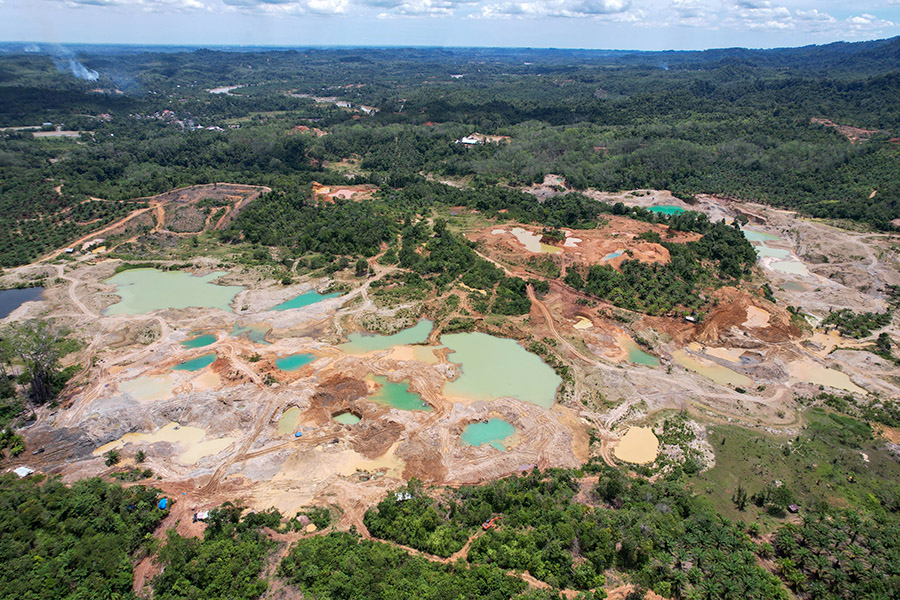
Drone photo: Junaidi Hanafiah/Mongabay Indonesia
Environmental Crisis
Ahlul Fadl, Climate Justice Mainstreaming Campaign Manager at Walhi Riau, said that national and regional moratoriums are needed to counter corporate hegemony. Permits are often issued without fairness, transparency, or public participation.
“A moratorium must be grounded in legal, environmental, and social audits to expose violations such as land conflicts and ecosystem destruction.”
A similar view was expressed by Muhammad Herwan, Deputy Chairman of the Riau Community Leaders Communication Forum (FKPMR). Natural resource wealth, he said, has instead deepened poverty.
“A moratorium is a turning point for efficient and sustainable management. Strict oversight, post-mining reclamation, and law enforcement must be ensured.”
Erwin Basrin, Director of the Conservation and People’s Alliance (Akar) Bengkulu, said mining activities have shown the government’s failure to protect the environment and Indigenous communities.
“Mining destroys the environment and seizes the rights of Indigenous peoples. A moratorium is not a choice; it is an ethical and constitutional necessity to ensure justice.”
According to Erwin, the government must immediately revoke problematic permits and halt the issuance of new ones. “Ensure that post-mining reclamation processes are conducted responsibly.”
The coalition stresses that a mining permit moratorium is a first step toward reforming natural resource governance in Sumatra. Civil society must be involved in evaluation processes, data transparency must be ensured, and law enforcement against illegal mining violations across Sumatra’s provinces must be strengthened.
Writer: Junaidi Hanafiah
Source: Mongabay