


6 Things That Must Be Followed Up from Korsup Minerba
Korsup Minerba began in 2014 in 12 provinces and then continued to 19 other provinces starting in December 2014. Korsup Minerba was carried out to encourage the creation of…

Policy Brief: Coordination and Supervision (Korsup) KPK and Mineral & Coal Mining Permit Governance
This brief capture how Coordination and Supervision of Corruption Eradication Commission (KPK) running since 2014. At the first time, National Movement on Saving the Natural…
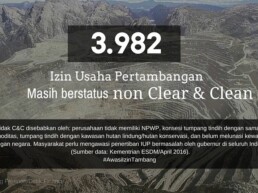
3.982 IUPs Are Still Non-C&C
As of May 16, 2016, there were still many Mining Business Permits (IUP) with non C&C status. This C&C IUP is caused by the company not having NPWP, concessions overlapping…
Planning for Oil and Gas Management Proposed by Civil Society
Civil society sees Oil and Gas Law no. 20/2001 is very exploitative without any aspect of planning, where oil and gas are a strategic resource which is the main energy source. On…

Energy Governance and Saving the Natural Environment
Answering the challenges from Sustainable Development, Paris Agreement, and saving the natural resources, PWYP Indonesia presented "Energy Governance and Saving the Natural…
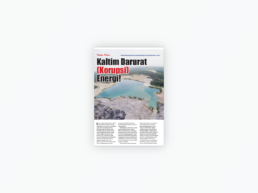
Energy Corruption Emergency in East Kalimantan
At present, the energy crisis in East Kalimantan is inevitable. The level of dependence on fossil energy is still high (71% fuel oil, coal 2%, and other sources 27%). Meanwhile,…