


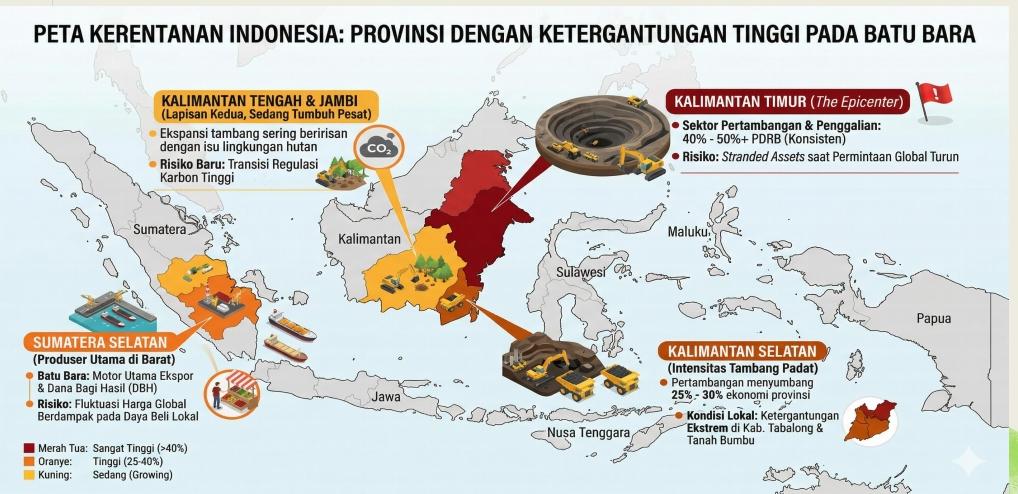
High dependence on the coal sector poses a major challenge to the economic sustainability of coal-producing regions, especially amid constantly shifting market dynamics. Therefore, these regions need to diversify their economic base rather than relying solely on coal.
Martha Jesica Solomasi Mendrofa, Policy Research and Just Transition Manager at the Institute for Essential Services Reform (IESR), stated that the economic sustainability of coal-dependent regions—such as Paser in East Kalimantan and Muara Enim in South Sumatra—is at risk amid current market changes and the global energy transition.
“To address this, economic transformation in coal-producing regions must be directed toward developing competitive and interconnected local economic diversification,” she said during a discussion titled “Coal Dependency and the Challenges of Regional Economic Transformation” at Pesta Media 2026.
Thus, regions should not only seek replacement sectors but also build cross-sector synergies to create greater local economic value.
IESR’s research titled Just Transition in Indonesia’s Coal Producing Regions: Case Studies of Paser and Muara Enim shows that this dependency is reflected in the significant contribution of revenue-sharing funds (DBH) from coal mining taxes and royalties to regional budgets (APBD), reaching 20% in Muara Enim and an average of 27% in Paser.
Martha noted that in coal-producing areas, the challenges of transition are becoming increasingly complex because economic dependence on the sector has not been matched by adequate preparedness for alternative economic opportunities.
This condition, she added, creates real risks, such as job losses and mounting pressure to address longstanding social and economic inequalities.
On the other hand, differing interests among stakeholders—particularly capital owners who tend to maintain the coal industry—are further slowing the pace of change.
Limited community involvement, she said, has also hindered the development of a shared vision for the transition.
“This situation shows that without inclusive and well-directed transformation planning, coal-dependent regions will become increasingly vulnerable to market dynamics and the direction of the global energy transition,” she said.
 The paradox of coal policy
Aryanto Nugroho, National Coordinator of Publish What You Pay (PWYP) Indonesia, said Indonesia’s dependence on coal must be taken seriously in discussions on energy sovereignty.
This is particularly important as the government is accelerating energy transition policies—shifting from fossil fuels such as coal and oil to renewable energy sources like solar, wind, and hydropower.
However, Aryanto argued that current government policies reveal a paradox.
“On one hand, the government has a grand vision to achieve net zero emissions before 2050, including converting coal-fired power plants to renewable energy. On the other hand, many policies contradict this goal.”
For example, last year, Bahlil Lahadalia, Minister of Energy and Mineral Resources, issued Ministerial Decree No. 314.K/TL.01/MEM.L/2024 on the National Electricity General Plan (RUKN).
The document shows that national power generation will continue to rely on fossil fuels, including coal, until 2060.
In addition, the renewable energy mix target has been lowered—from 23% by 2025 to around 17–19% in the draft Government Regulation on National Energy Policy (RPP KEN).
Dependence on coal is also reflected in fiscal policy. Non-tax state revenue (PNBP) from minerals and coal remains very high, contributing 52.84% of exports. Meanwhile, coal-fired power plants (PLTU) continue to expand, dominating around 85% of national power generation capacity.
According to Aryanto, heavy reliance on a single energy source creates various systemic risks, including vulnerability to global commodity price fluctuations, which can directly affect both national and regional economic stability.
At the regional level, coal-dependent areas face significant economic risks when global prices or demand decline.
This condition, he said, can trigger declining regional revenues, rising unemployment, and widening economic inequality.
Suraya Abdulwahab Afiff, an anthropologist from the University of Indonesia, emphasized that solutions focused solely on reducing carbon emissions—without addressing social and economic inequalities—will not fully resolve the problem.
Therefore, community involvement is key to the success of the energy transition.
“A just transition requires active participation from various stakeholders, including workers, local communities, consumers, and the broader public.”
Such participation, she added, is crucial to ensure that policies fully account for social and economic impacts.
The way forward
Aryanto stressed that energy transformation is not only about reducing coal production. It must also include the creation of new sources of growth through renewable energy development and sustainable economic activities.
“Economic diversification is key,” he said.
These efforts should not rely solely on central or local governments but also require active participation from the private sector, particularly energy companies, to invest in the energy transition.
He also highlighted a “people and planet-centered” approach—policies that prioritize environmental protection and the rights of communities and workers.
“With this approach, the energy transition is expected to focus not only on economic aspects but also on social justice and environmental sustainability,” Aryanto concluded.
Source: Mongabay