


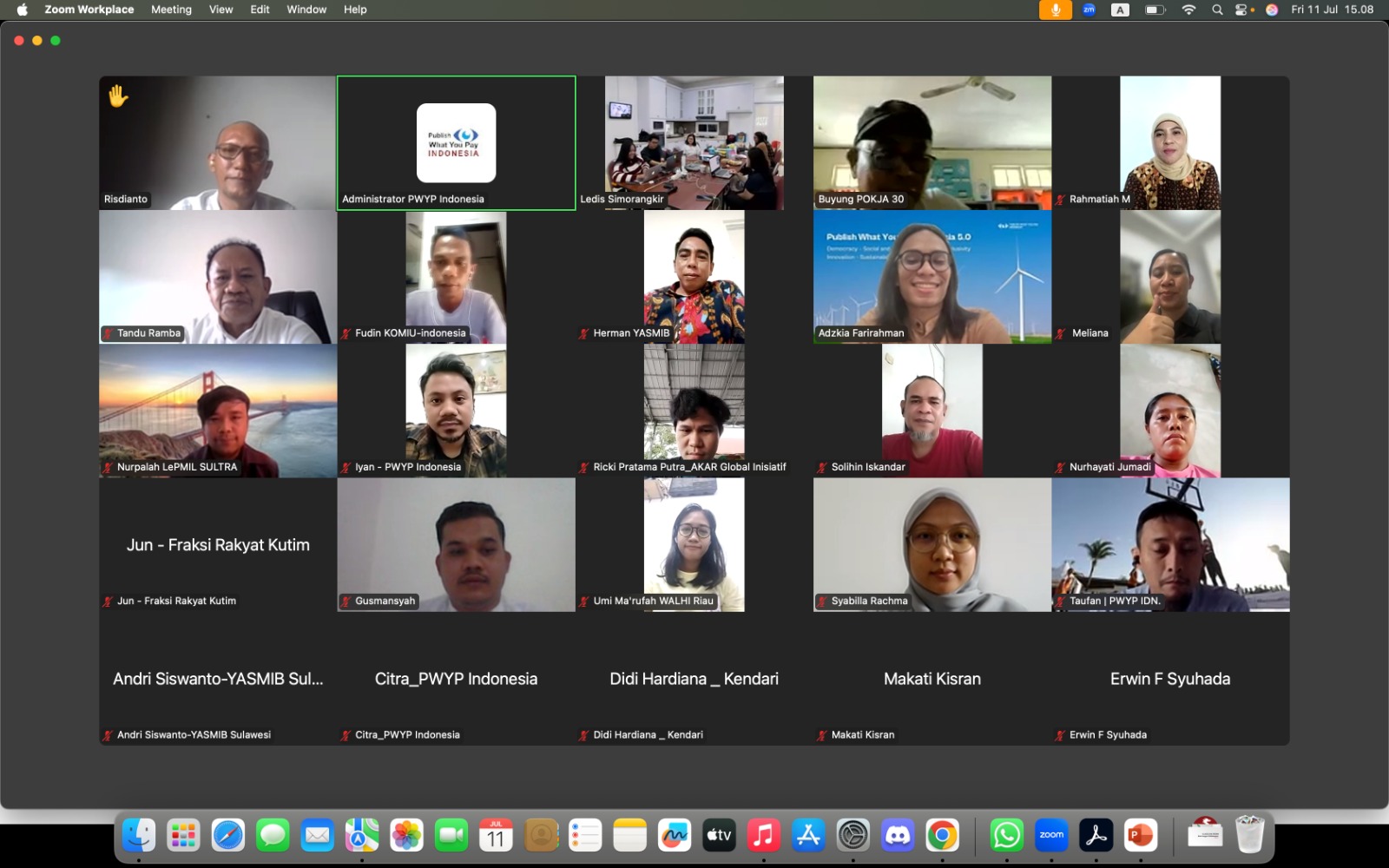
Jakarta, July 11, 2025 – PWYP Indonesia hosted the PWYP Knowledge Forum (PKF), a regular discussion event organized by the National Secretariat of PWYP Indonesia in collaboration with its 31 coalition members across Indonesia, conducted in a hybrid format. The event featured speakers from diverse backgrounds, including the Indonesian Center for Environmental Law (ICEL), POKJA 30, affected community members, and Forum Rakyat Kalteng (FRK), to discuss the critical need for law enforcement in the energy and natural resources sector.
The discussion stemmed from civil society’s concerns over the persistently weak enforcement in the extractive sector. With the establishment of the Directorate General of Law Enforcement (Ditjen Gakkum) under the Ministry of Energy and Mineral Resources (ESDM), civil society aimed to assess the institutional opportunities and challenges, hoping to strengthen natural resource governance.
Saffana Rezky, a researcher from ICEL, explained that the formation of Ditjen Gakkum ESDM was mandated by the President and formalized through Presidential Regulation No. 169 of 2024 on the Ministry of Energy and Mineral Resources. The directorate’s primary responsibilities include compliance oversight, administrative sanctions, and law enforcement. It oversees five directorates, four of which were discussed in detail:
Directorate of Prevention, Intelligence, and Complaint Handling: Focuses on public complaints and intelligence to collect and analyze data in the ESDM sector, while also developing policies and technical guidelines to prevent violations.
Directorate of Criminal Enforcement: Handles investigations of criminal cases under regulations such as the Mining Law, Geothermal Law, and Electricity Law, separating criminal and civil violation handling.
Directorate of Dispute Resolution and Administrative Sanctions: Manages disputes and administrative sanctions, including potential lawsuits by the Ministry of ESDM, though its authority is not as robust as under the Environmental Protection and Management Law (PPLH).
Directorate of Asset and Evidence Management: Oversees assets and evidence before court proceedings, such as power plants or LPG involved in legal cases.
Saffana emphasized the importance of safeguards in law enforcement to avoid harming communities and highlighted the need for preventive oversight to stop violations before they occur.
Buyung Marajo from POKJA 30 outlined four key issues in the extractive sector: corruption, environmental damage, conflicts, and criminalization. He cited examples like licensing disputes, compensation issues, relocations, and partnerships in Kalimantan that have sparked tensions among communities, companies, and the government. He criticized the slow bureaucratic response, systematic negligence, and justification of violations under National Strategic Projects (PSN). “Even legal operations violate regulations, let alone illegal ones,” he stressed. Buyung urged Ditjen Gakkum ESDM to transparently address past violations without political pressure and proposed a 100-day performance evaluation specifically for Kalimantan.
Voices of Affected Communities
Warta, a resident of Muara Kate, Paser Regency, shared the community’s bitter experiences with legal mining operations that have reduced agricultural land, led to accusations of land encroachment, and resulted in unjust law enforcement where small-scale farmers face action while companies go unpunished. Welcoming Presidential Regulation No. 169/2025 on Ditjen Gakkum ESDM as a new hope, she stressed the need for clear complaint mechanisms, whistleblower protection, and tangible actions to ensure safe farming, not just “showy gestures.”
Confusion over Authority and Risks of Criminalization
Erwin from FRK highlighted public confusion over the overlapping authority of Ditjen Gakkum ESDM and the Ministry of Environment and Forestry (KLHK) in addressing environmental violations. He noted that ESDM often treats Environmental Impact Assessments (AMDAL) as mere formalities without thorough verification, despite the need for ESDM’s scrutiny. Ninda from ICEL added that KLHK only provides recommendations for revoking environmental permits to sectoral ministries, which are often ignored, underscoring the need for synergy without overlap. Tandu Ramba, focusing on just energy transition, warned that the transition is often overlooked, and Ditjen Gakkum ESDM risks becoming a “double-edged sword” that could criminalize communities, necessitating vigilance to avoid further burdens.
Hopes and Next Steps
The discussion underscored that the establishment of Ditjen Gakkum ESDM is a progressive step, though fraught with challenges. Communities hope the institution will operate independently, transparently, and responsively, free from bureaucratic entanglements or political pressures. Strengthening public complaint mechanisms, protecting whistleblowers, and fostering synergy with KLHK are critical to ensuring just law enforcement.
As a concrete step, Buyung proposed forming a working group in Kalimantan to monitor Ditjen Gakkum’s performance during its first 100 days. “This is a breath of fresh air, but we must ensure Gakkum is truly effective and not swayed by higher interests,” he concluded.
The event reaffirmed PWYP Indonesia’s commitment to promoting transparent, accountable, and community-oriented natural resource governance. With Ditjen Gakkum ESDM in place, there is hope for more effective law enforcement in the energy and natural resources sector, protecting community rights and supporting sustainable development.
Author: Ledis Sixti Nauli
Reviewer: Meliana Lumbantoruan